Bingodays
An ADHD to-do app that turns overwhelming task lists into a Bingo board—designed, built, and shipped solo with AI-assisted development.
The Problem
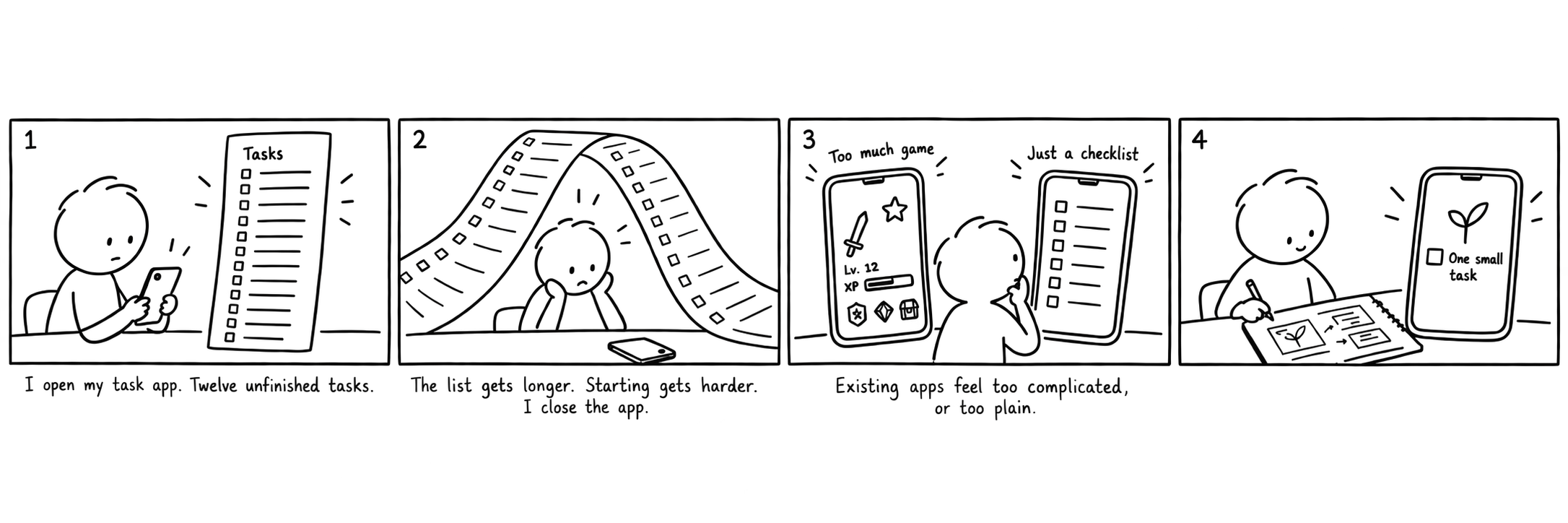
Most to-do lists ask you to finish everything, in order. For ADHD brains, that’s not motivating—it’s paralysing. The longer the list gets, the harder it becomes to start anything on it.
I’ve dealt with this myself for years: opening a task app, seeing twelve unfinished items, and closing it again without doing any of them. Existing ADHD-focused apps tend to either over-gamify (turning tasks into a chore-shaped RPG) or under-gamify (a plain checklist with a nicer font). I wanted something in between—lighter than a game, warmer than a checklist.
The Idea
Reframe the list as a board. Let people start anywhere, not just at the top.
Bingodays organises tasks into a 3 × 3, 4 × 4 or 5 × 5 grid instead of a vertical list. There’s no “first” task—you tap whichever tile you actually feel like doing, and completing a few tiles builds the same “almost there” pull as a real bingo card. No forced order, no guilt for skipping around.
Designer + AI
I designed and shipped Bingodays solo. AI handled most of the engineering—the product decisions stayed mine.
Rather than loose prompts, I worked by writing the interaction like a spec: what a tile should do when tapped, how the grid should resize, what “done” should feel like versus just look like. That level of detail forced me to make interaction decisions upfront, instead of discovering them by accident in the generated code.
Not everything AI produced matched the tone I wanted on the first pass—and catching that is where the actual design work happened.
Details That Mattered
A handful of small decisions I wouldn’t hand off to AI to make alone.
Any-order completion
No enforced first task—breaking the “all or nothing” trigger that makes long lists feel unstartable.
Adjustable grid density
3 × 3 to 5 × 5 lets the board match how much a day actually holds, instead of one-size-fits-all.
Low-stakes reward loop
Points unlock mystery stickers—kept deliberately gentle rather than tuned to be addictive.
A diary, not a streak to protect
Progress is framed as “thank yourself for showing up,” not a streak you’re punished for breaking.
What It Taught Me About Working with AI
Bingodays is small, but it changed how I think about AI as a design tool—not as an autopilot, but something I have to direct precisely. Writing exact specs, catching when a generated interaction drifted from the emotional intent, and knowing which calls—reward pacing, visual tone, what not to build—had to stay entirely mine.